
When Every Second Counts: The Science Behind Fast, Accurate Picking
Gent Ivziku • December 17, 2025
When every second matters in a warehouse, the difference between fast and slow, accurate and error-prone, often comes down to the hidden science behind how people move, react, and make decisions. Speed and precision are not just operational goals, they are cognitive and physical challenges. Wearable scanning technology is changing the equation by aligning with how the human body and mind naturally work, allowing pickers to move quickly without sacrificing accuracy.
One of the biggest performance factors is latency. Every scan triggers a chain of events that take place in milliseconds, and while each moment feels insignificant, those tiny delays compound across thousands of picks. Wearable scanners with low latency sensors capture barcodes even during motion, decode labels instantly, and send confirmations with virtually no delay. When workers no longer pause to wait for their device, they eliminate the micro pauses that silently drag down productivity. Over the course of a shift, saving milliseconds on each scan translates to hours of regained efficiency.

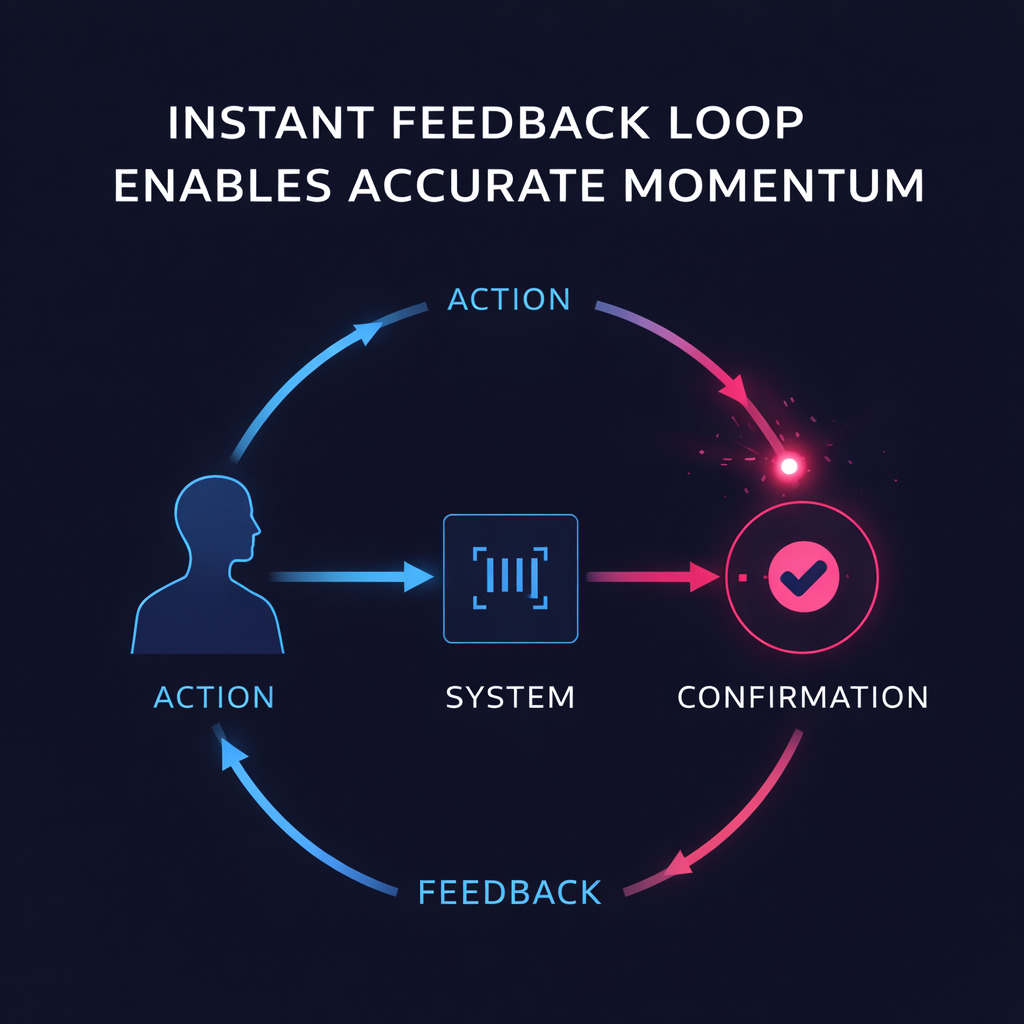
Feedback is another crucial part of achieving fast, accurate picking. Traditional handheld devices often rely on screens that workers must stop and read, breaking their rhythm. Wearables create uninterrupted flow by using immediate haptic, audio, or visual confirmation. Workers know instantly, without thinking, checking, or slowing down, whether a pick is correct. This kind of instant feedback loop reduces mental load and supports continuous movement, enabling accuracy through instinct rather than constant verification.
Underlying all of this is the role of cognitive ergonomics. Speed involves the body, but accuracy lives in the brain. The most efficient workflows are those that reduce cognitive friction, eliminate unnecessary decisions, and support natural human motion. Wearable scanners remove the need to grab, hold, or repeatedly reposition a device. They reduce distractions, simplify task repetition, and allow workers to stay focused on the environment rather than the technology. With less mental effort required to manage the tool, workers direct more attention to completing tasks correctly.
When latency, feedback, and cognitive ergonomics work together, wearable scanning consistently outperforms traditional handheld scanning. Operations see faster picking speeds, fewer errors, lower fatigue, and much shorter training time because the device behaves like an extension of the hand rather than another piece of equipment to manage. Workers move continuously, react intuitively, and maintain accuracy even at high speed.
The future of picking is moving toward systems that adapt to workers in real time. As wearable technology evolves, it will incorporate predictive guidance, personalized feedback, and deeper AI powered insight to support even faster and more precise workflows. The science behind fast, accurate picking is growing more sophisticated, but the principle remains the same. When technology follows human design, every second becomes an opportunity to move smarter, faster, and with greater confidence.
About the Author

Gent Ivziku
Client Success Manager, Lotwork
Gent is a Client Success Manager at Lotwork, helping teams find smarter, faster ways to get work done using wearable tech and hands-free scanning. He’s passionate about simplifying warehouse and logistics workflows and enjoys working closely with customers to find the right fit for their needs. Outside of work, he’s a big fan of soccer and loves diving into great movies and TV shows whenever he gets the chance.


Discover how Lotwork demonstrated 2P1S workflows, wearable barcode scanning, and Wireless Light Tags at LMD Toronto 2026 to improve warehouse efficiency and workflow flexibility.

Discover how 2P1S (Pick-Place-Scan) and hands-free wearable solutions are transforming warehouse workflows. Visit Booth 21 at LMD 2026 to see it in action.

Explore Lotwork’s MODEX recap showcasing wearable technology, pick-to-light solutions, and hands-free workflows designed to improve warehouse efficiency and accuracy.