
Why the $100B Logistics Software Market Just Hit a Brick Wall
February 24, 2026
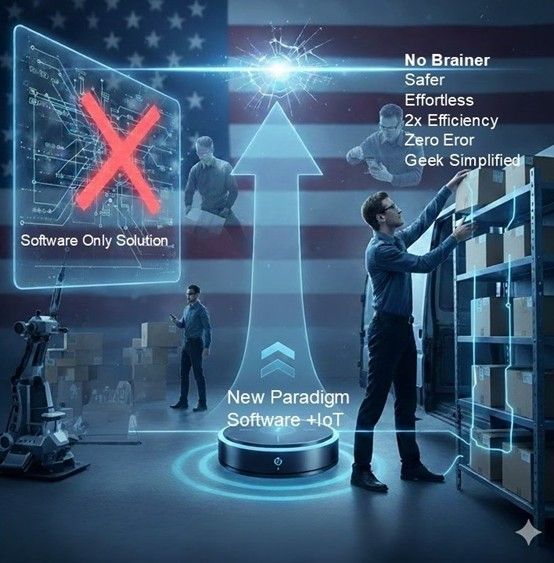
We’ve all seen it: dozens of route optimization startups, all promising the same "perfect" algorithm. But here’s the cold truth: Software alone has reached its ceiling. In the U.S., we are throwing hundreds of millions of dollars into optimizing "bits" (code), while the "atoms" (the physical packages) are still in total chaos.
The Entropy Increase Problem: You can give a driver the most efficient route possible, but if they spend 2 minutes digging through a messy van to find one package or have to reorganize parcels multiple times per day, your algorithm & AI just failed.
Currently, over 50% of last-mile drivers’ and package handlers’ time and energy is
wasted on "Non-Value-Added" actions:
- Digging through piles to find a specific tracking number.
- Constantly checking a phone or handheld device.
- Reorganize packages after every few stops.
- The mental fatigue of making micro-decisions at every turn.
The Solution? It’s not more software. It’s Ultra-Low-Power IoT. 🔋
We need to stop asking workers to think and start letting the packages speak.
By integrating Ultra-low-power IoT hardware with software, we move from "Route Optimization" to "Physical Flow Automation." When a package "calls" the worker—turning search time and decision time into zero-time, no-brainer tasks—that is when we see efficiency double.
The Bottom Line: If we invest 100x more into pure software, we might get a less than 1% additional efficiency. We are at the point of diminishing returns.
The next frontier of U.S. logistics isn't in a better app; it’s in the marriage of Software + IoT Hardware
to defeat physical chaos.
Agree? Or do you think software still has room to run? Let’s discuss in the comments.

Every year around this time, warehouses get the same squeeze: more orders, tighter deadlines, and no room for mistakes. Most of the advice is about hiring more people or upgrading your systems. Those things help, but there’s a cheaper place to look first, and it’s the small stuff your pickers do hundreds of times a shift. Picture a picker’s routine. Grab the scanner, scan the barcode, set the scanner down, handle the item. Repeat. Each round takes a couple of seconds, so nobody notices. Over a full shift, though, it adds up.

Discover how Lotwork customized ring scanners for Direct Relief, adapting barcode formats and glove-friendly bands to fit their workflow.

Discover how Lotwork demonstrated 2P1S workflows, wearable barcode scanning, and Wireless Light Tags at LMD Toronto 2026 to improve warehouse efficiency and workflow flexibility.